
We live in an era where streaming algorithms try to dictate the culture, feeding us a never-ending loop of the same formulaic content. But every now and then, a platform steps up, reads the room, and decides to curate rather than just broadcast. Enter Rock Da Crowd TV.
They aren’t just throwing shows at a wall to see what sticks; they are digging deep into the archives to resurrect the real heavyweights of Black television. If you want to understand the true DNA of today’s complex anti-heroes, brilliant tech-geniuses, and unapologetic power couples, you have to go back to the source. We’re talking about an era when network television was forced to reckon with Black brilliance, style, and autonomy in real-time.
Rock Da Crowd TV just dropped a holy trinity of late-80s and mid-90s excellence that fundamentally shifted the culture. Adjust your dials, fix your posture, and take notes. Here are the three undisputed classics you need to stream right now.
1. A MAN CALLED HAWK: THE APEX PREDATOR OF COOL

Before the internet tried to mass-produce “swag,” Avery Brooks gave us the ultimate, unteachable masterclass. Originally introduced as the enigmatic, scene-stealing enforcer on Spenser: For Hire, Brooks played Hawk with such overwhelming magnetism and smooth, lethal elegance that a spin-off wasn’t just a good idea—it was a television mandate. When A Man Called Hawk touched down in 1989, it packed up Hawk’s signature brand of street-level justice and moved it straight into the beating heart of Chocolate City: Washington, D.C.
If Vibe existed to give out awards for television style back then, Hawk would have retired the trophy on night one. The look was legendary: the gleaming shaved head (years before MJ made it a global phenomenon), the flawlessly tailored, wide-shouldered silk suits, and the dark shades worn indoors, outdoors, day, or night. He didn’t just walk into a scene; he reclaimed the space. Hawk glided through the gritty D.C. night in a sleek, midnight-blue BMW 635CSi and packed a massive .357 Magnum Colt Python, but his mind was his primary weapon.
Brooks, a classically trained powerhouse, infused Hawk with a deep, soulful intellect. He operated by his own autonomous code—he wasn’t a cop, and he didn’t answer to the bureaucracy of the system. Backed by the legendary, thumping jazz-fusion basslines of Stanley Clarke, Hawk doled out justice with a jazzman’s timing. He would quote poetry and critique fine art just as effortlessly as he dismantled a room full of street thugs without wrinkling his lapel. He was the undisputed blueprint for every sophisticated, unapologetic Black anti-hero that followed.
2. SNOOPS: BLACK LOVE AND HIGH-STAKES HUSTLE
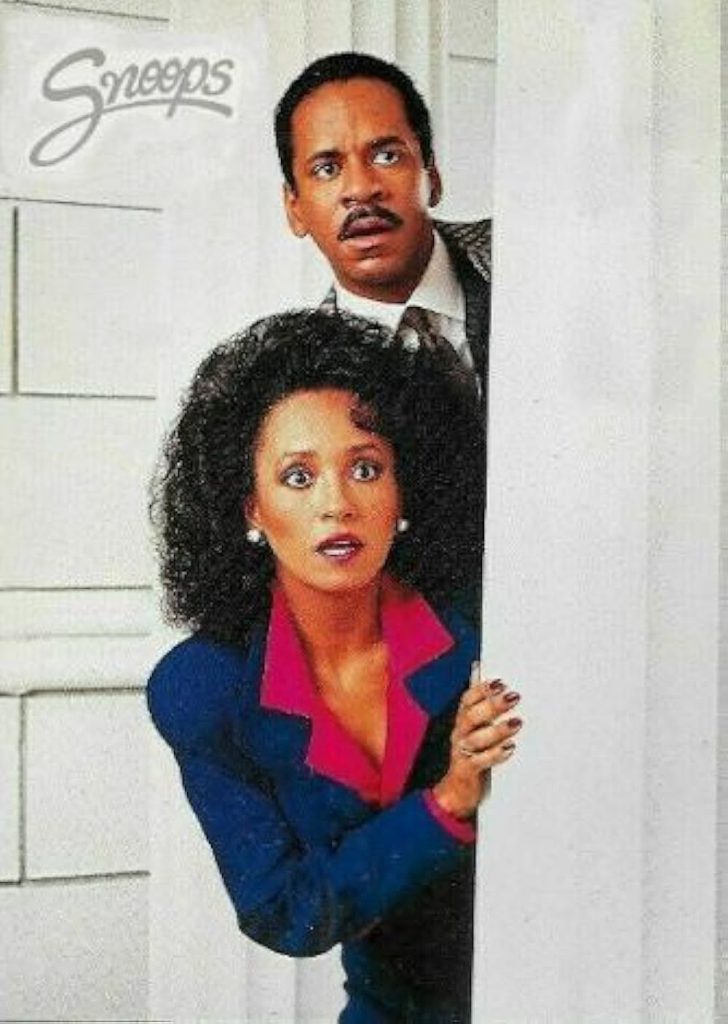
When you think of the late 1980s, the landscape of Black television was largely defined by the multi-camera sitcom. But in 1989, television royalty Tim Reid (fresh off his critically acclaimed masterpiece Frank’s Place) and his real-life wife, the effortlessly elegant Daphne Maxwell Reid, decided to flip the script entirely. They gave us Snoops, a show that completely redefined what a Black power couple looked like on prime-time CBS.
Forget the struggle narratives. Chance and Micki Dennis were the absolute pinnacle of Black opulence, intellect, and grace. Chance was a brilliant criminologist and Georgetown professor, while Micki was a sharp, high-ranking government protocol officer dripping in late-80s high-fashion couture. Together, they moonlighted as amateur sleuths, solving murders and untangling conspiracies in the highest, most exclusive echelons of Washington, D.C. society. They were the Nick and Nora Charles of the hip-hop generation—trading rapid-fire, sophisticated banter over expensive wine before catching a killer.
What made Snoops so radical was its mere existence. It showcased Black love as a partnership of absolute equals, draped in luxury and fueled by intellect. They navigated the corridors of power without ever compromising their essence or code-switching for the audience. It was a stylish, comedic, and thoroughly grown-up procedural that proved we didn’t just belong in the sitcom living room—we belonged in the penthouse, outsmarting the criminals the local PD couldn’t touch.
3. M.A.N.T.I.S.: THE PIONEER OF AFROFUTURISM

Long before Wakanda became a global household name and the Marvel Cinematic Universe dominated the box office, there was Dr. Miles Hawkins. Created by Sam Raimi and Sam Hamm, and hitting the Fox network in 1994, M.A.N.T.I.S. was a seismic shift in the superhero genre. Starring the commanding Carl Lumbly, it gave us the first Black superhero to anchor a live-action television series, and it did so with a premise that was decades ahead of its time.
The setup was pure Afrofuturism before the term went mainstream, wrapped in a deeply resonant social narrative. Dr. Hawkins was a wealthy, fiercely brilliant scientist who was paralyzed from the waist down by a police sniper’s bullet during a riot. Instead of letting a broken system defeat him, he used his massive intellect and vast resources to build the Mechanically Augmented Neuro Transmitter Interception System (M.A.N.T.I.S.)—a high-tech, bulletproof black exo-suit that restored his ability to walk and granted him superhuman strength, speed, and agility.
Operating out of a secret underwater Seapod and cruising through Port Columbia in a flying submarine called the Chrysalis, Hawkins waged a one-man war against a corrupt establishment and organized crime. But the real flex wasn’t the gadgetry; it was Lumbly’s performance. He played Hawkins with a quiet, brooding intensity, emphasizing that his greatest superpower wasn’t the exoskeleton—it was his massive, unparalleled mind. M.A.N.T.I.S. proved that a Black man could be the tech-genius, billionaire savior of the city, blazing a trail for the diverse sci-fi landscapes we enjoy today.
THE VERDICT
Rock Da Crowd TV isn’t just offering a nostalgic trip down memory lane; they are actively preserving the culture. A Man Called Hawk, Snoops, and M.A.N.T.I.S. aren’t just vintage television shows. They are historical documents of Black excellence, style, and innovation. They broke molds, defied industry expectations, and laid the foundational concrete for the renaissance of Black storytelling we see today.
Cancel your weekend plans, pour up something top-shelf, and hit play. The vault is wide open, and class is officially in session.